Ditapis dengan
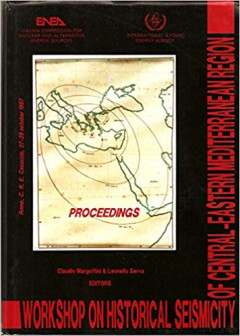
Proceedings Workshop on Historical Seismicity of Central-Eastern Mediterranea…
The study of historical earthquakes is very often the place to start in designing critical facilities. For this reason, accurate investigations on ancient events have been performed in all those countries in which the knowledge of the maximum level of hazard could directly affect the realization of important manmade structures. Italy is the most seismic area among the European industrialized co…

Volcanic and Tectonic Hazard Assessment for Nuclear Facilities
Geoscientists worldwide are developing and applying methodologies to estimate geologic hazards associated with the siting of nuclear facilities. Understanding such hazards, particularly in the context of the long functional lifetimes of many nuclear facilities, is challenging. This book documents the current state-of-the-art in volcanic and tectonic hazard assessment for proposed nuclear facili…

Isotope Geology
Radiogenic and stable isotopes are used widely in the earth sciences to determine the ages of rocks, meteorites and archeological objects, and as tracers to understand geological and environmental processes. Isotope methods determine the age of the Earth, help reconstruct the climate of the past, and explain the formation of the chemical elements in the Universe. This textbook provides a compre…

Deep Geological Disposal of Radioactive Waste
Deep Geological Disposal of Radioactive Waste presents a critical review of designing, siting, constructing and demonstrating the safety and environmental impact of deep repositories for radioactive wastes. It is structured to provide a broad perspective of this multi-faceted, multi-disciplinary topic: providing enough detail for a non-specialist to understand the fundamental principles involve…

Relativity: The Special and the General Theory
The Nobel Prize-winning scientist's presentation of his landmark theoryAccording to Einstein himself, this book is intended "to give an exact insight into the theory of Relativity to those readers who, from a general scientific and philosophical point of view, are interested in the theory, but who are not conversant with the mathematical apparatus of theoretical physics." When he wrote the book…

Methods for Reducing Occupational Exposures During the Decommissioning of Nuc…
This book consist : Introduction; Scope; Basic considerations; Methods for reducing occupational exposures; Health physics progamme; Optimization of exposure reduction techniques; Effects on waste management; Relevant experience; Application to other facilities; and Summary. (Jml)


Kimia inti & Radiokimia, Buku Kedua: Radiokimia dan Penggunaan Radioisotop
Membahas tentang radiokimia dan penggunaan radioisotop baik sebagai perunut maupun sebagai sumber radiasi dalam kimia, pertanian, geologi, kedokteran dan pengetahuan bumi dan angkasa luar, yang memerlukan beberapa perhatian khusus, disebabkan oleh adanya bahaya terhadap radiasi yang dipancarkan. (Jml),

Experiment in Nuclear Science
This text provides hands-on experiments in nuclear radiations and discusses their interactions with matter, detection and measurement, and applications in the physical and life sciences.

Design, Construction, Operation, Shutdown and Surveillance of Repositories fo…
This book consist : Introduction; Scope; Basic considerations; Repository design and construction; Operation of repositories; and Shutdown and surveillance of repositories. (Jml)
 Karya Umum
 Filsafat
 Agama
 Ilmu-ilmu Sosial
 Bahasa
 Ilmu-ilmu Murni
 Ilmu-ilmu Terapan
 Kesenian, Hiburan, dan Olahraga
 Kesusastraan
 Geografi dan Sejarah