Ditapis dengan
Technical Review of Acceptance Criteria for Pressurized Heavy Water Reactor Fuel
Fuel acceptance criteria can be used, among other things, as key inputs in the determination of operating limits and conditions for reactor operational states, in the determination of fitness for service criteria for anticipated operational occurrences, in the formulation of special safety system trip set points for accident conditions, and in the determination of a plant's safe operating envel…

Accident Analysis for Nuclear Power Plants with Graphite Moderated Boiling Wa…
This book consist : Introduction; Structural characteristics of RBMKs; Classification of initiating events; Acceptance criteria; Requirements for analysis; Selection of initial and boundary; Discussion of events; and Presentation of results. (Jml)
Country Nuclear Fuel Cycle Profiles, Second Edition
This book consist : Introduction; Review of worldwide nuclear fuel cycle activities; and Country nuclear fuel cycle profiles. (Jml)
Status and Trends in Pyroprocessing of Spent Nuclear Fuels: IAEA TECDOC No. 1967
The importance of recycling the spent nuclear fuel through partitioning processes has been recognized worldwide for increasing and sustaining nuclear energy. Therefore, the development of advanced partitioning processes, based either on hydrometallurgical or on pyrometallurgical technologies, has received an increasing interest in recent years. Moving towards industrial demonstration, partition…
Safety Reports Series No. 30: Accident Analysis for Nuclear Power Plants with…
The objective of this publication is to provide specific guidance for accident analysis for nuclear power plants with pressurized water reactors, taking into account the specific design features of these reactors. This guidance covers all steps required to perform such analyses, including selection of initiating events, acceptance criteria, computer codes, modelling assumptions, preparation of …
Accident Analysis for Nuclear Power Plants with Pressurized Water Reactors
This book consist : Introduction; Initiating events and their categorization; Acceptance criteria; Selection of initial and boundary conditions; Analysis of core cooling and system pressure for a decrease of reactor coolant flow; Analyisis of core cooling and system pressure for decrease of heat removal by the secondary side; Analysis of core cooling for LOCAs; Analysis of primary to secondary …
Accident Analysis for Nuclear Power Plants with Pressurized Heavy Water React…
Deterministic safety analysis (henceforth referred to as accident analysis) is an important tool for confirming the adequacy and efficiency of provisions within the defence in depth concept for the safety of nuclear power plants (NPPs). Due to the close interrelation between accident analysis and safety, an analysis that lacks consistency, is incomplete or of poor quality is considered a safety…
Intercomparison of Techniques for Inspection and Diagnostics of Heavy Water R…
To foster international collaboration in nuclear power technology, the IAEA has conducted a coordinated research project (CRP) on Intercomparison of Techniques for Heavy Water Pressure Tube Inspection and Diagnostics. This publication presents the results of the second phase of the CRP, dealing with blister characterization by in situ non-destructive examination (NDE) techniques and determinati…
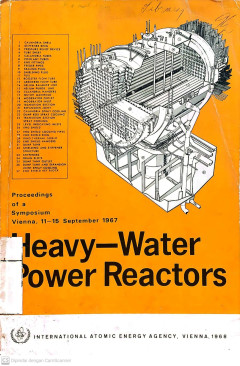
Heavy-Water Power Reactors: Proceedings of a Symposium Vienna, 11-15 Septembe…
Heavy-water reactors have evoked a great deal of interest since the early days of atomic power development. These reactors, by virtue of their good neutron economy, offer certain advantages over other types, including lower fuel inventory, versatility in fuel cycle with the possibility of using natural or enriched uranium as well as thorium, better fuel utilization, and consequently low fuel cy…
 Karya Umum
  Filsafat
  Agama
Agama  Ilmu-ilmu Sosial
  Bahasa
  Ilmu-ilmu Murni
  Ilmu-ilmu Terapan
  Kesenian, Hiburan, dan Olahraga
  Kesusastraan
  Geografi dan Sejarah