Ditapis dengan
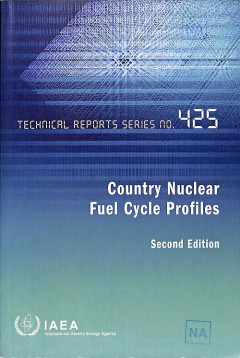
Country Nuclear Fuel Cycle Profiles, Second Edition
This book consist : Introduction; Review of worldwide nuclear fuel cycle activities; and Country nuclear fuel cycle profiles. (Jml)
Status and Trends in Pyroprocessing of Spent Nuclear Fuels: IAEA TECDOC No. 1967
The importance of recycling the spent nuclear fuel through partitioning processes has been recognized worldwide for increasing and sustaining nuclear energy. Therefore, the development of advanced partitioning processes, based either on hydrometallurgical or on pyrometallurgical technologies, has received an increasing interest in recent years. Moving towards industrial demonstration, partition…
Technical Review of Acceptance Criteria for Pressurized Heavy Water Reactor Fuel
Fuel acceptance criteria can be used, among other things, as key inputs in the determination of operating limits and conditions for reactor operational states, in the determination of fitness for service criteria for anticipated operational occurrences, in the formulation of special safety system trip set points for accident conditions, and in the determination of a plant's safe operating envel…
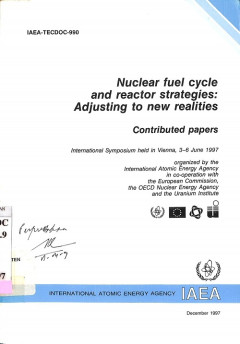
Nuclear Fuel Cycle and Reactor Strategies: Adjusting to New Realities, Contri…
This book consist : Opening session; Session I. Alternatif long term strategies for sustainable development: Rapidly increasing electricity consuption in Asia countries and future role of nuclear energy, etc; Session II. The US program for disposition of excess weapons plutonium, etc; Session III. Development potential for thermal reactors and their fuel cycles, etc; Session IV. Risk associated…

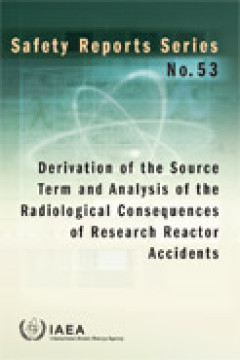
Derivation of the Source Term and Analysis of the Radiological Consequences o…
This report provides a set of suggested methods and practices for determining the source term and analysing the radiological consequences of research reactor accidents. It provides safety analysts, regulators, and reactor facility management and operations staff, with the calculation methods and techniques necessary for deriving the source term. This includes all factors relevant to the formati…

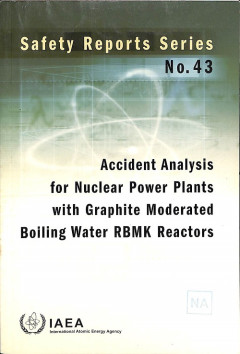
Accident Analysis for Nuclear Power Plants with Graphite Moderated Boiling Wa…
This book consist : Introduction; Structural characteristics of RBMKs; Classification of initiating events; Acceptance criteria; Requirements for analysis; Selection of initial and boundary; Discussion of events; and Presentation of results. (Jml)
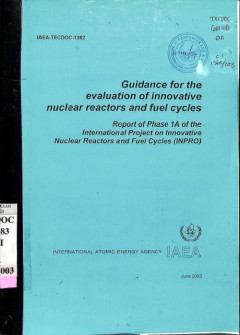
Guidance for the Evaluation of Innovative Nuclear Reactors and Fuel Cycles: R…
This book consist : Chapter 1. Background; Chaper 2. Nuclear power prospects and potentials; Chapter 3. Definitions of selected terms within inpro; Chapter 4. Basic principles, user requirements and criteria for innovative nuclear reactors and fuel cycles; Chapter 5. Innovative nuclear technology assessment inpro methodology; and Chapter 6. Conclusions and recommendation. (Jml)
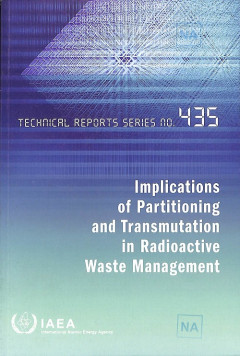
Implications of Partitioning and Transmutation in Radioactive Waste Management
This book consist : Introduction; Potential impact of partitioning and transmutation on radioactive waste management; Non-proliferation aspects of partitioning and transmutation; Fuel cycles; Partitioning; Transmutation; Additional waste management considerations; Conclusions; and Recommendations to decision makers. (Jml)
 Karya Umum
  Filsafat
  Agama
Agama  Ilmu-ilmu Sosial
  Bahasa
  Ilmu-ilmu Murni
  Ilmu-ilmu Terapan
  Kesenian, Hiburan, dan Olahraga
  Kesusastraan
  Geografi dan Sejarah